
At some point, female empowerment and emotional exhaustion started speaking in the same voice: rise above, come back stronger, you’re unstoppable. These phrases show up on ceramic mugs, Instagram captions, and well-meaning texts from people who genuinely care. However they carry a heavy message: whatever you’re feeling right now, your job is to get over it.
The language of female strength has become its own kind of pressure. Here’s what actually helps.
When “You’ve Got This” Feels Like a To-Do List
The cultural pressure on women to be strong has taken on an exhausting shape recently. Today, being a strong woman means you have to be emotionally resilient, professionally successful, physically fit, incredibly generous, and completely unbothered by difficulties, all at the same time. When you tell a woman she’s a warrior or a boss who can handle anything, it feels like an instruction manual. Handle this, be stronger than this, and don’t let this slow you down.
What gets lost in that framing is permission:
- Permission to be completely overwhelmed.
- Permission to need help without feeling guilty.
- Permission to struggle without having to pretend you’re already overcoming it.
When searching for the right words of encouragement for women, we often default to these high pressure scripts. Telling someone they’re strong before you’ve acknowledged that their situation is genuinely hard doesn’t feel like support. It just feels like a polite way of telling them to skip the part where it hurts.


Silent Audit Every Woman Runs in Her Head
To understand why our words of encouragement for women need to change, we have to be honest about the silent exhaustion many women navigate every single day.
Most women live with a constant, low-level internal audit: Am I being too emotional? Not emotional enough? Too aggressive? Too soft? Am I focusing too much on work, or neglecting my home? This emotional labor, managing everyone else’s comfort, reading the room, and making space for everyone else’s needs, is so normalized that we forget it’s work at all. When a woman hits a wall, the last thing she needs is a cheerleader telling her to perform more strength, what she needs is plain, honest validation.
We need to offer empowering words for women going through hard times that don’t demand immediate resilience. Not “You’re going to get through this,” but “This is a lot, and it makes total sense that you’re exhausted.”
Why We Need to Drop the Hustle Culture in Relationships
Motivational language, the kind that tells you to rise, grind, and come back better, has a major flaw: it views rest as a crime. It treats recovery as something you only do so you can push harder in the next round, and implies that the only point of surviving a hard time is to emerge as a faster, stronger, and more upgraded version of yourself. That mindset is exhausting. Sometimes, the only point of getting through something hard is simply to get through it, at your own pace, without owing anyone a spectacular transformation at the end.

For women who are already demanding too much of themselves, hustle language reinforces a toxic internal script: that rest must be earned, that needing help is a personal failure, and that the only correct response to hardship is to work harder, rather than letting someone else hold them for a moment.
What It Actually Looks Like to Help Someone Heal
The most comforting, empowering words for women going through hard times have a few things in common:
- They don’t rush her to feel better right away.
- They notice her pain without forcing her to explain or justify it.
- They remind her that her worth isn’t tied to her productivity or how well she keeps it together.
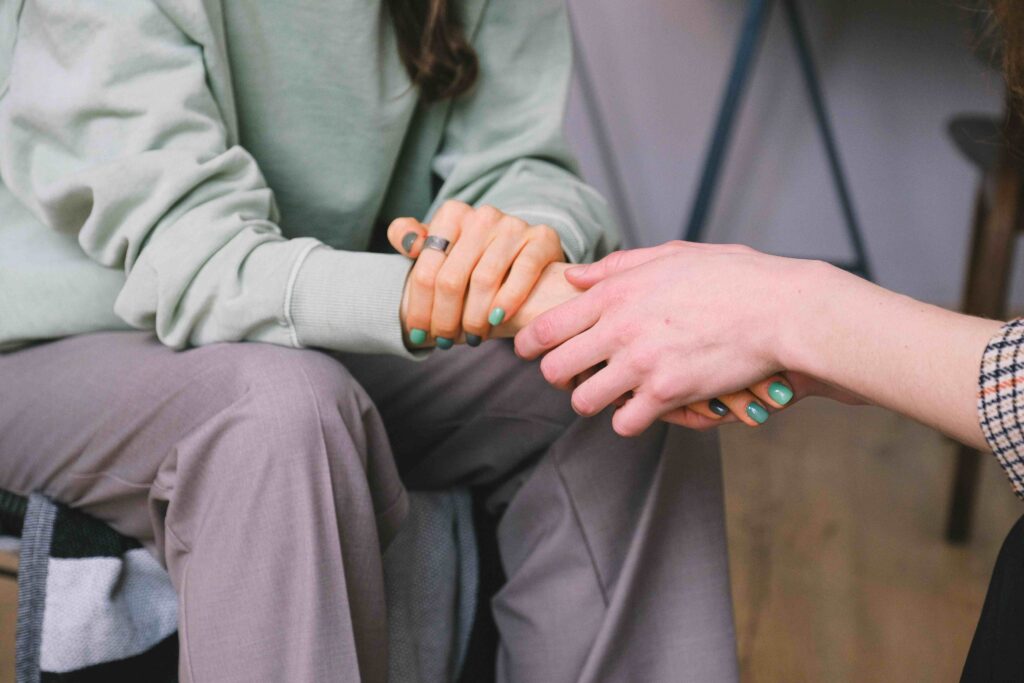
There is a massive difference between telling a woman she is strong and telling her that you see how much she is carrying. The first is a label that comes with heavy expectations. The second is an observation that asks for nothing in return. One forces her to keep the performance going, while the other allows her to drop the act and breathe.
Telling someone they’re allowed to not be okay, and that their needs aren’t an inconvenience, offers a relief that motivational phrases simply can’t touch. It removes a brick from their backpack instead of asking them to run faster while wearing it.
Conclusion: The Encouragement Worth Giving
Real encouragement actually holds up a mirror to show a woman what’s already there, giving her a safe space to rest, and expecting absolutely nothing in return. None of this means we should stop encouraging the women in our lives. They still need to hear that they can keep going, that support needs to be specific, grounded in reality, and offered after you’ve acknowledged the pain, not before.
Saying: “I’ve watched you handle some really tough things, and I know how much you care about this,” lands completely differently than a generic “You can do it!” Because it’s real evidence, it means you’re paying attention. When we intentionally choose genuine words of encouragement for women rather than clichés, we offer real comfort. The most effective, empowering words for women going through hard times are the ones that remove a pressure rather than adding one.
What’s Your Take?
Have you ever felt more exhausted by someone telling you to stay strong when you were already at your limit?
What are the best words of support you have ever received?
Tell us in the comments below, or share this article with a woman in your life who needs permission to just breathe today.