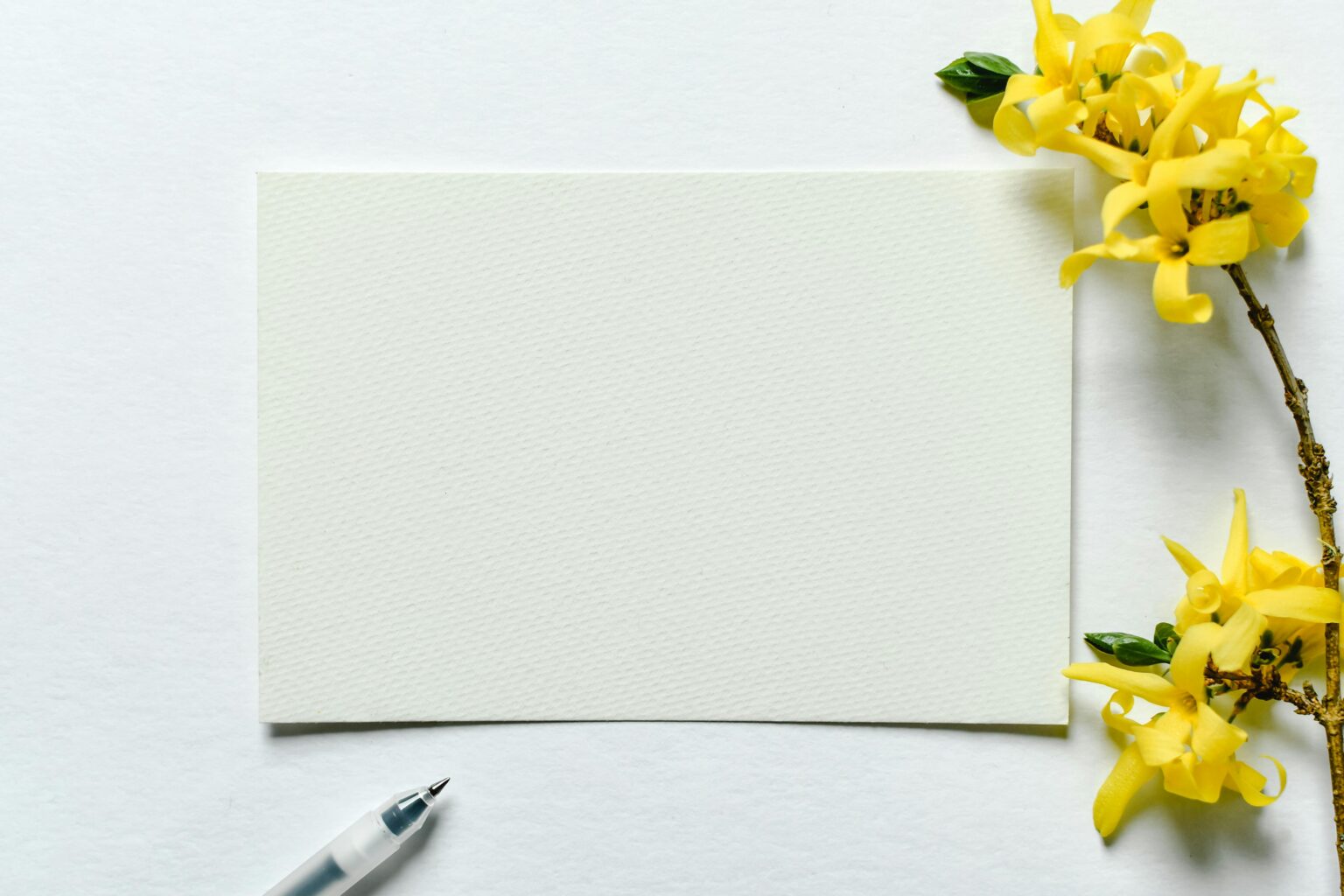
Getting totally stuck when looking at a blank piece of paper is a remarkably common experience, and it has nothing to do with how much you value the relationship. We experience this sudden writer’s block simply because we put too much pressure on ourselves to condense a multi-year friendship into a single, flawless sentence. Trying to figure out exactly what to write in a birthday card for a friend accidentally transforms a basic, unpolished greeting into a stressful personal test, making us overthink what should be a straightforward moment of connection.
Empty Card Roadblock
Think about that moment when you sit down at your kitchen table with a fresh card, slide the cardboard out of its sleeve, and uncap your pen. You have known this person for 5 years, shared countless late-night conversations, and helped them move apartments twice. Yet, as you stare at that empty white background, your hand completely freezes up. If you just look at the paper trying to invent a profound, cinematic declaration of your bond, the silence starts to feel incredibly forced and performative.
Opening the inner page shouldn’t feel like sitting down to take a high-stakes university exam, the sudden pressure to capture a multi-year friendship in a single sentence creates an instant mental roadblock that leaves us totally stuck.


Massive Relational Weight of Small Text
Big gestures are completely overrated. A massive surprise party or a heavy, dramatic speech might look incredible on a social media feed, but real relationships actually live and breathe in the small, unpolished gaps between those events. That awkward pause you experience while staring down at a blank piece of cardboard is a genuine psychological pattern interrupt.
Fighting through that sudden brain freeze to figure out what to write in a birthday card for a friend is a declaration that this specific bond can’t be satisfied by a lazy, one-tap template. The friction itself is the proof. Spending an extra minute struggling over a simple pen stroke signals to your own mind that this person sits entirely outside the superficial noise of your daily digital feed, holding a permanent space that is built to last.
Dismantling the Performance of Modern Greetings
Trying to sound incredibly sophisticated or overly formal in a card message feels entirely unnatural. If your daily text thread with a companion consists entirely of short inside jokes, shifting into a heavy, poetic style just because it is their birthday feels incredibly forced and performative. When you bypass that anxiety and write something simple like “Happy birthday mate, glad you are in my corner,” you’re actively rejecting that performance.
You’re matching their exact energy, showing that you understand the true boundaries of your bond without trying to force an artificial moment. That level of unpolished honesty is exactly what makes a card stick around in a bedroom drawer for years instead of ending up in the recycling bin before the weekend ends.

Reclaiming the Lost Art of Being Seen
The modern world is incredibly loud, and it is easy to feel invisible even when we are constantly connected online. A standard birthday notification feed is a crowded, exhausting place where every single message looks identical. Shifting your focus toward intentional communication means using your words to make someone feel truly seen as an individual.
Think about the difference between receiving fifty identical automated comments online versus opening a single physical card that references a specific conversation you had six months ago. That micro-connection instantly breaks through the digital noise, it serves as a real-world anchor, proving that your friendship is a transactional line on a social media app, and also a living, breathing connection that is built to last.
Sustaining Depth in a Convenient World
It’s incredibly easy to see why we succumb to the comfort of automated scripts and external templates. We overextend our schedules and try to manage our social circles through shortcuts, waiting for tools to tell us how to speak to our people. However our psychological health is built on the steady accumulation of small, unvarnished moments of joy. The next time a brother’s birthday pops up on your calendar, don’t reach for a fast, digital default message or let an empty card freak you out.

Step away from the serious, performative scripts of modern media and lean into the simple reality of your shared history. Recognizing that choosing what to write in a birthday card for a friend carries immense weight, remembering that long-term emotional security is built entirely on a foundation of simple, connected presence.
Key Takeaways
Straining over empty stationery is an indicator of relational anxiety stemming from a desire to cut through modern digital noise. True emotional depth is maintained by rejecting sophisticated formulas and matching the exact, unpolished shorthand of your daily interactions. By referencing specific shared history instead of relying on automated scripts, you transform a basic card into a physical anchor that helps people feel genuinely seen. Ultimately, showing up with an authentic, hand-written message preserves long-term trust and reinforces a foundation of simple, connected presence in an increasingly convenient world.
What’s your go-to move when your mind completely locks up over a birthday card?
Do you try to find a funny quote online, or do you just give up and sign your name at the bottom?
Drop your thoughts in the comments below, or share this with a friend who always leaves card-writing to the absolute last minute!